
The common damage signs of carpenter ants are a clean and smooth gallery pattern with sharp edges inside the wood. Besides, you will get piles of droppings mixed with body parts near the entry points. On the other hand, termites will create tunnels inside the wood with a rough and ragged look filled with pellets, mud, and droppings. You will also see entry points, bubbling paint, and hollow-sounding wood.
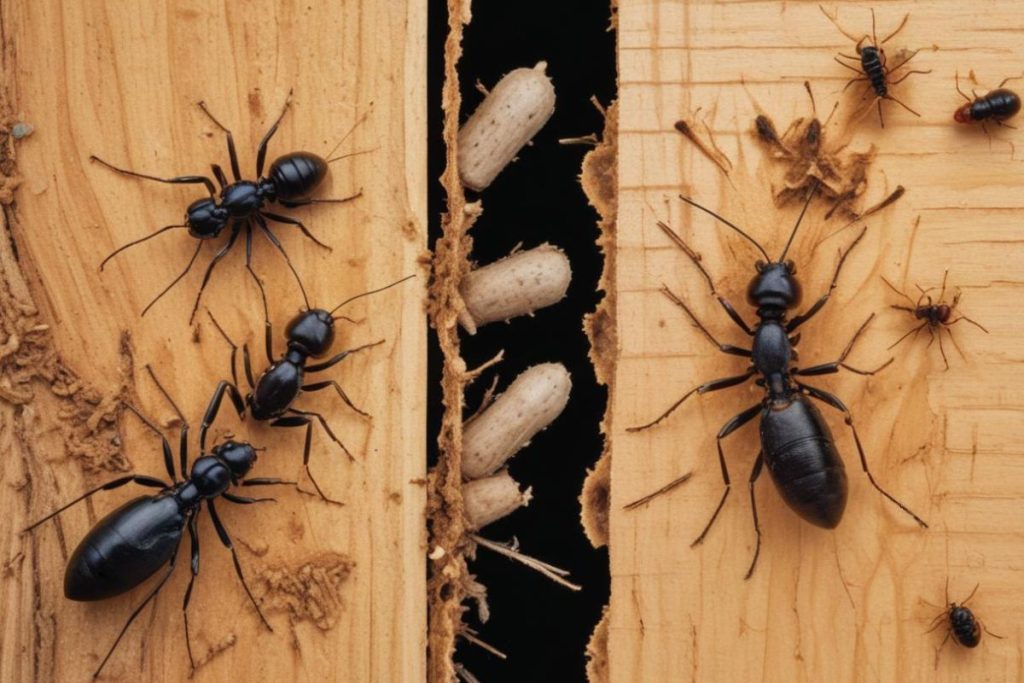
Carpenter ants damage signs in Singapore
Carpenter ants do not eat wood to meet their hunger; instead, they excavate the wood to build nests for living and reproducing. During this, they leave behind the smooth and clean gallery pattern with sharp edges inside the wooden properties. You will find small piles of droppings (sawdust, coarse and irregular) and wood shavings near entry points such as frames, fascia boards, windows, or any other infested wooden structures. They like to build their satellite nests near food sources and moist areas. The damage will increase as they expand their nests.
Termite damage signs in Singapore
Termites eat wood cellulose for nutrition, so the damage caused is higher than that caused by ant infestation. They create tunnels inside the wood that look rough and ragged and are filled with fecal pellets, mud, and termite droppings. You will find pellet-shaped, uniform termite fecal pellets or termite frass (pellets) near the infested areas, such as Internal structural wood, support beams, floor joists, and drywall frames. Apart from the frass, you will see small entry points or holes in the infested wooden structure. Bubbling paint and hollow-sounding wood are also common signs of termites. You will see mud tubes, foundation cracks, and deep colonies at your properties as well, especially drywood and moisture-rich wood.
Key Differences: Damage Signs of Carpenter Ants vs Termites
| Aspect | Carpenter Ants | Termites |
| Wood Damage Pattern | Smooth, clean galleries with sharp edges | Rough, ragged tunnels filled with mud, fecal pellets, or termite droppings |
| Presence of Frass | Yes — Wood shavings mixed with carpenter ant droppings | Rough, ragged tunnels filled with mud, fecal pellets, or termite droppings |
| Mud Tubes / Mud Tunnels | No | Yes, especially with subterranean termites |
| Primary Nesting Behavior | Builds satellite nests inside moist or damaged wood | Colonizes deep inside wood and underground (worker termites, queen, etc.) |
| Entry Point Indicators | Holes, wood shavings, near moist or rotted wood | Mud tubes, foundation cracks, and bubbling paint |
| Damage Location | Often around window frames, fascia boards, and exposed rooflines | Internal structural wood, support beams, floor joists, and drywall frames |
| Swarming Behavior | Yes — Winged ants are seen in spring; swarms are visible near light sources | Yes — Winged termites in the reproductive swarmer stage are seen near windows and vents |
| Droppings Appearance | Resembles sawdust, coarse and irregular | Pellet-shaped, uniform termite fecal pellets |
| Paint and Surface Signs | Rarely causes surface bubbling | Often causes bubbling paint, hollow-sounding wood |
| Damage Speed | Slow — damage accumulates over months to years | Rapid, especially by subterranean termites under moist conditions |
| Moisture Preference | Requires moist, softened wood | Prefers both drywood and moisture-rich wood (based on species) |
| Lifecycle Impact on Damage | Damage increases with satellite nest expansion | Damage driven by growing colonies and worker termite activity |
| Type of Damage | Mechanical excavation for nesting (does not eat wood) | Consumes wood cellulose for nutrition, structural weakening |
| Professional Treatment | Can be treated with a bait station, pest control services, and essential oils | Requires Sentricon system, liquid barriers, or full-termite bait station |
| Common Control Providers | Western Exterminator, Yale Pest Control, Miller Pest | Eliminate ‘Em, Pronto Pest Management, MightyMite Termite Services |
Damage Severity for Carpenter Ants vs Termites
The damage severity for these wood-destroying insects varies significantly since carpenter ants do not consume the wood for nutrition. Their damage severity increases slowly over time, unlike termites, which consume wood and create tunnels rapidly. It causes more significant structural damage very fast.
Pest control suggestions
Use bait stations, insecticides, and professional treatment for carpenter ants, and use liquid termite barriers, deploy termite bait stations, soil treatment, and professional experts are needed for termites.
How to Prevent Carpenter Ants and Termites
- Remove moisture by fixing leaky pipes, installing a proper drainage system, and repairing water damage.
- Seal all the entry points for ants and termites.
- Avoid wood-to-soil contact at any cost.
- Remove tree stumps, wood debris, and old lumber near the home.
- Keep firewood off the ground and away from other wooden properties.
- Apply diatomaceous earth and boric acid around ant trails and termite zones.
- Have your home inspected by a professional.
If you are in Singapore and you need professional help, then call Termite Specialist, an NEA-certified pest control company with 13 years of experience. We offer an effective solution for termites and ants. The Termite Specialist PTE LTD office is in the Midview building. You can call us or you can visit our office at 50 Bukit Batok Street 23, #05-30 MIDVIEW BUILDING, Singapore. You can check our reviews to see what people say about us.
FAQ
Which is worse, carpenter ants or termites?
Termites are worse in terms of damaging your wooden structures since they consume wood and cause significant damage. Carpenter ants weaken the structure, but not like termites.
What is the difference between a termite hill and an ant hill?
A termite hill is more complex, larger, and made from saliva, soil, and feces. It is made to regulate temperature and humidity inside. On the other hand, ant hills are smaller, simpler, and made of soil or sand with less complexity.
Which is stronger, an ant or a termite?
Ants are stronger physically since they can carry 10 to 50 times their body weight easily. Soldier ants can easily overpower termites in direct combat. However, in terms of destroying the wooden structure, termites are stronger.